MAGNA’s annual report on the Brazilian advertising market, co-written by our team: the country’s economic and political context and investment in TV, digital, print, radio and out-of-home, with forecasts to 2027.
Format: Annual market report
Authors: Lucas Almeida and MAGNA Brazil
Date: 2023
Context
With around 215 million people, Brazil is the 5th or 6th most populous country in the world and the largest in Latin America, with close to a third of the region’s population and economic output. The study starts with the country before getting to the media.
Economy: GDP, household income, employment and foreign investment.
Technology and commerce: the spread of broadband and the growth of e-commerce.
Current affairs: the 2022 elections, won by Lula against Bolsonaro, and the new government’s proposals.
Regulation: Brazil is one of the few countries that allow political advertising on TV.
Key figures
Brazil is the largest advertising market in Latin America.
BRL 63 billion: Net advertising revenue in 2021: the world’s 9th largest market, between Canada and South Korea.
37 %: TV’s share, dominated by Grupo Globo, with 33% of the audience.
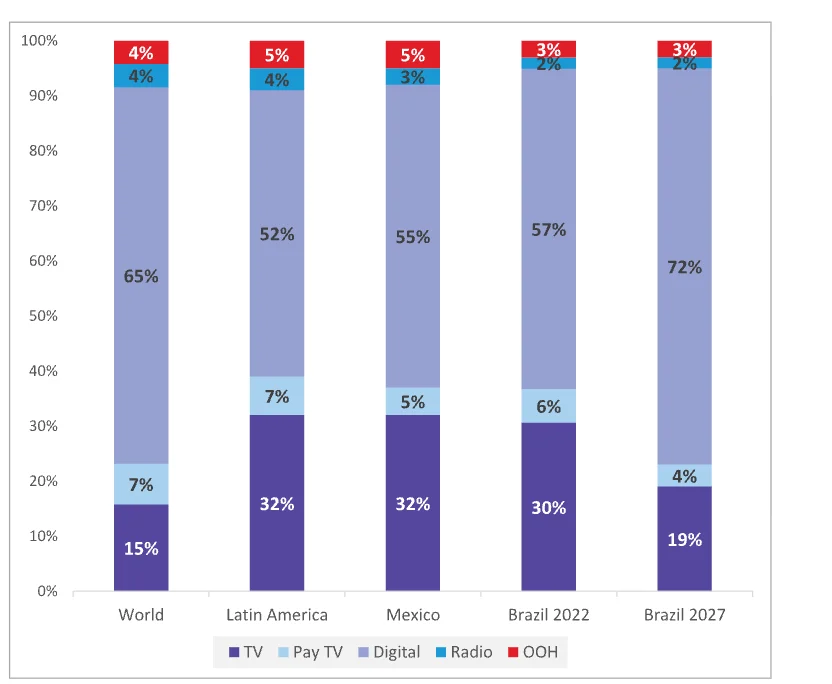
57 %: Digital’s share in 2022, above the Latin American average (52%), on its way to 65% in 2027.
USD 56: Advertising spend per capita in 2021, below the global average (148) and above Latin America (45).
Forecast
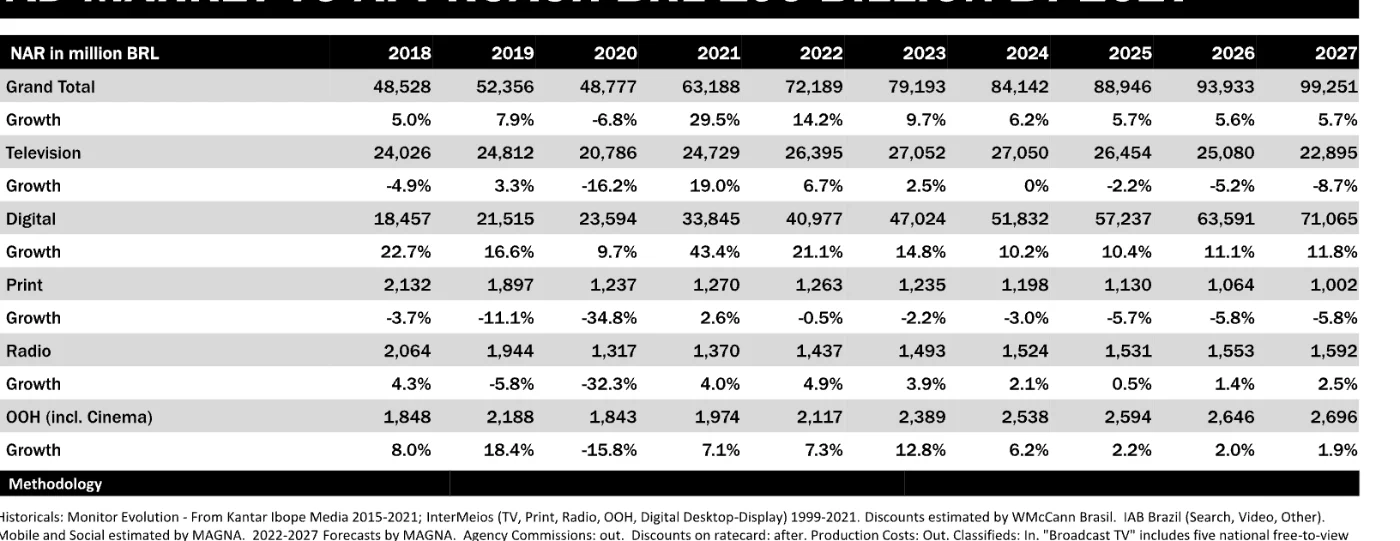
MAGNA expects the market to grow from BRL 63 billion in 2021 to close to BRL 100 billion in 2027. Growth comes from digital, which should rise by 10 to 11% a year between 2023 and 2027, while TV starts to decline from 2025.
Net advertising revenue by medium, 2018–2027 · MAGNA
Time spent
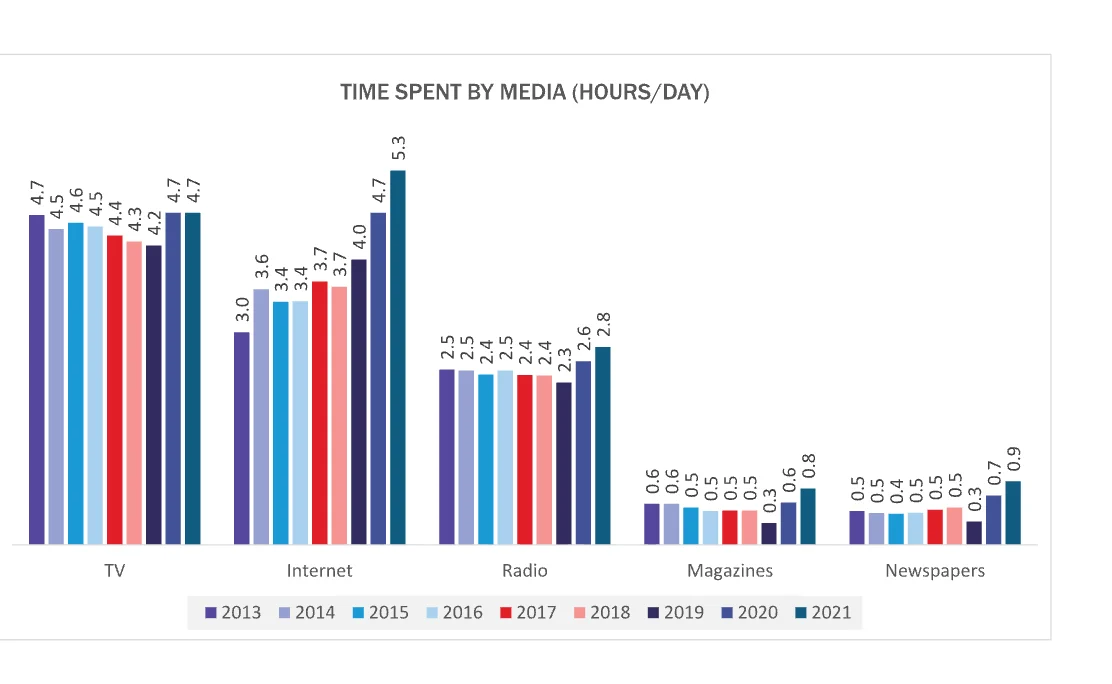
Brazilians watch around 8 hours of video a day, across free and pay TV, gaming and streaming, and spend around 5 hours a day online. TV still holds more than 4 hours a day, but in 2021 the internet overtook it: 5.3 versus 4.7 hours.
Hours per day with each medium, 2013–2021 · MAGNA
Investment by medium
Digital is already the largest medium: 57% of investment in 2022, above the Latin American average (52%). In 2021, digital advertising revenue grew by 72%, and digital’s share should reach 65% in 2027.
Share of each medium in investment: world, Latin America, Mexico and Brazil · MAGNA
Who invests
Retail is by far the biggest-spending sector, mainly on TV, followed by consumer services and media. Unilever is the largest advertiser across all media.
Net investment by sector in 2021, in billions of reais
Retail: 6,5
Consumer services: 6,2
Media and entertainment: 4,8
Finance and insurance: 3,9
Public and social services: 2,5
Telecommunications: 2,3
Pharmaceuticals: 2,1
Personal care: 2
Automotive: 1,4
Culture, leisure, sport and tourism: 1,4
Source: MAGNA, with data from Monitor Evolution (July 2022) · chart redrawn
Television
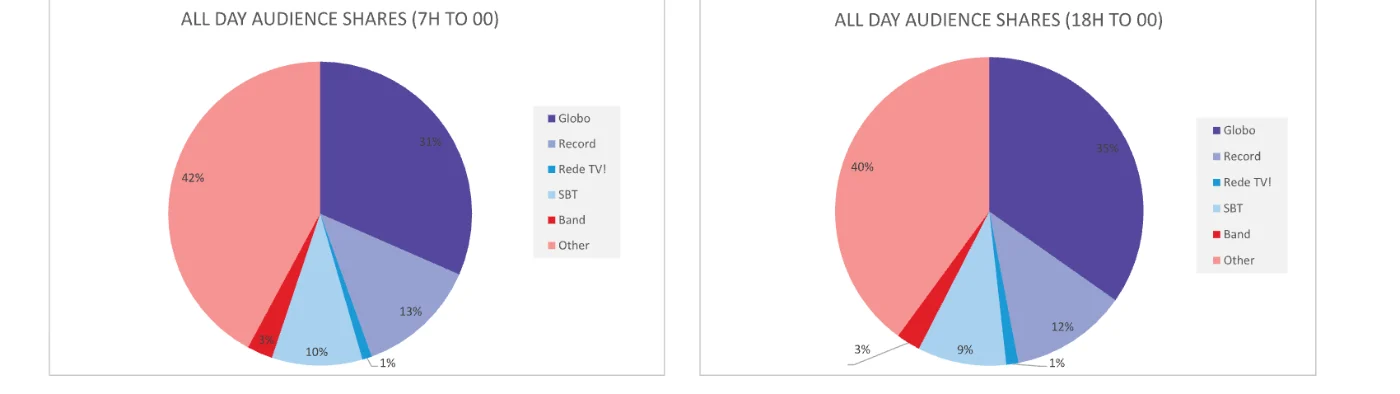
TV holds 37% of the market and has not lost audience as in other countries: telenovelas, sport and news are still watched live. Globo leads with 33% of the audience. At the 2022 World Cup, the streamer Casimiro broadcast 22 matches and reached 6.5 million viewers for Brazil–Croatia.
TV audience shares · MAGNA
Digital
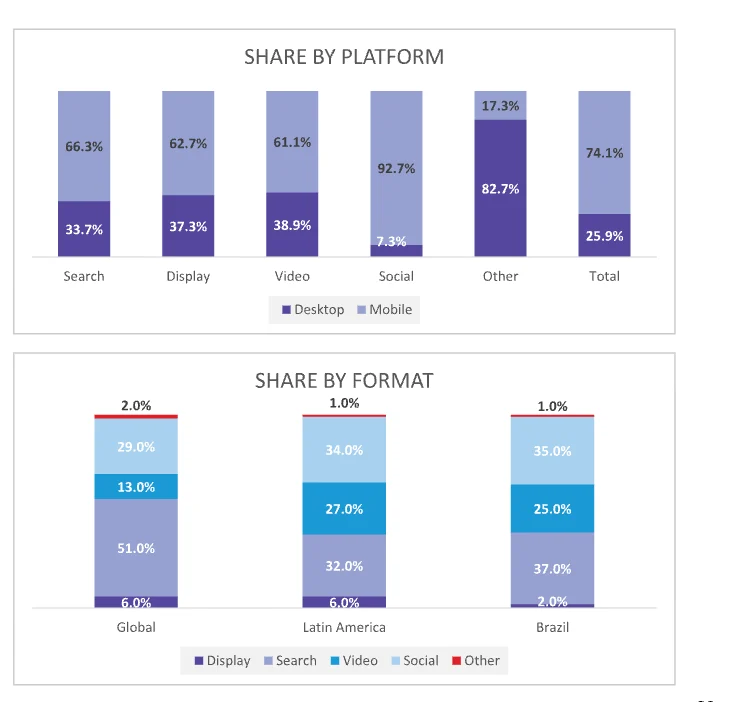
Brazil is a mobile-first digital market: around three quarters of digital investment goes to mobile formats, and over 90% in social. Social is the largest format, ahead of search and video, all above the global average. Display is just 2%.
Digital investment by platform and format · MAGNA
Most visited websites
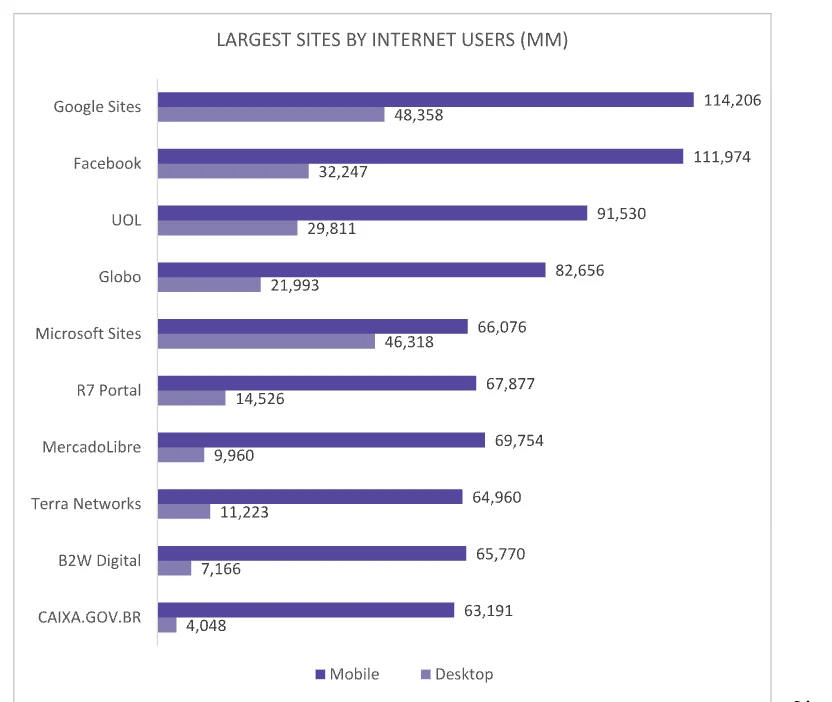
Google and Facebook lead, with more than 110 million unique visitors a month. Local websites such as UOL and Globo exceed 80 million. Mobile is the preferred device for all ten largest websites, including the online stores Mercado Livre and B2W.
Largest websites by number of users, in millions · MAGNA, with data from Comscore
Print and radio
Newspaper and magazine circulation has fallen sharply since 2015, and newspaper penetration is low, higher in the Southeast and South. Radio has remained stable, at around one billion reais a year in net revenue.
Out-of-home
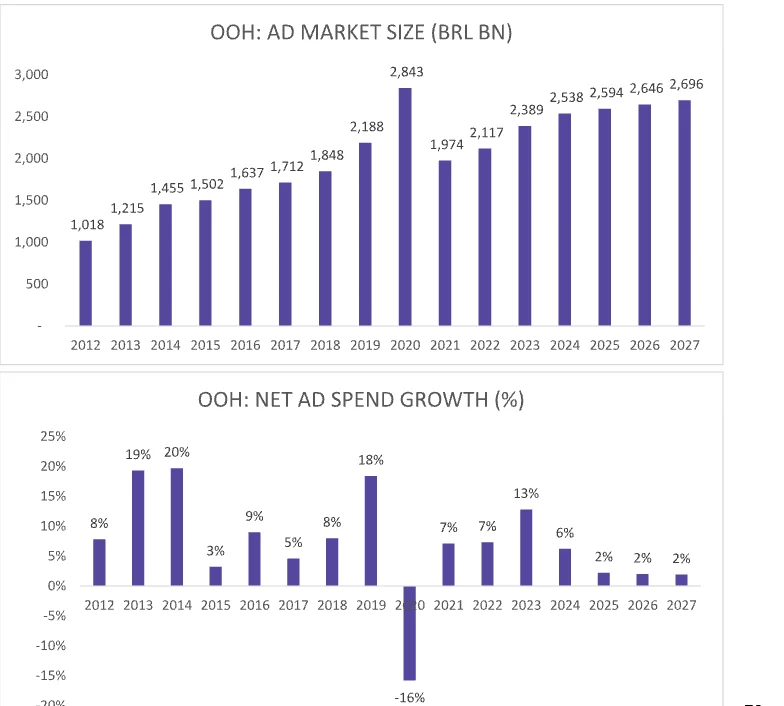
Out-of-home accounts for around 3% of investment and has swung widely with urban regulation. The 2007 Clean City law banned street advertising in São Paulo for several years and boosted indoor media. In 2022 out-of-home grew by 7%, and MAGNA forecasts +13% in 2023.
Out-of-home market and annual growth, 2012–2027 · MAGNA
Digital out-of-home
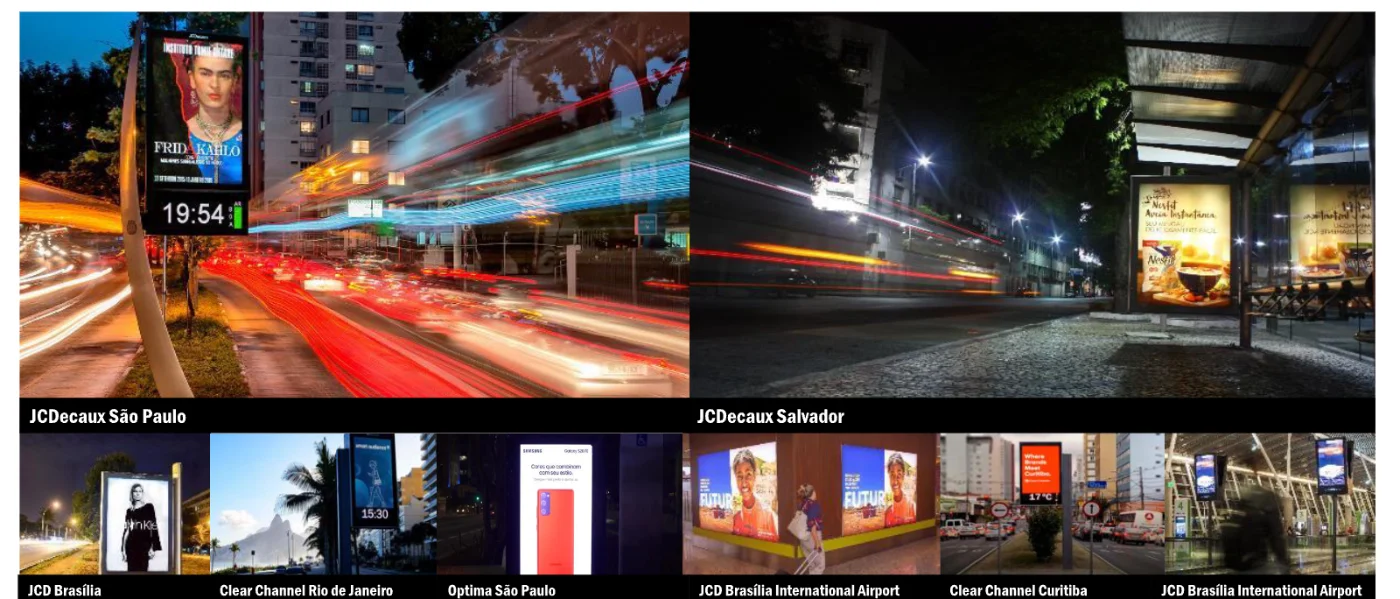
Digital out-of-home has grown by double digits every year since 2014, except in 2020, with the expansion of operators such as JCDecaux and Clear Channel. MAGNA expects it to reach close to half of out-of-home investment in 2027, above the Latin American average (30%).